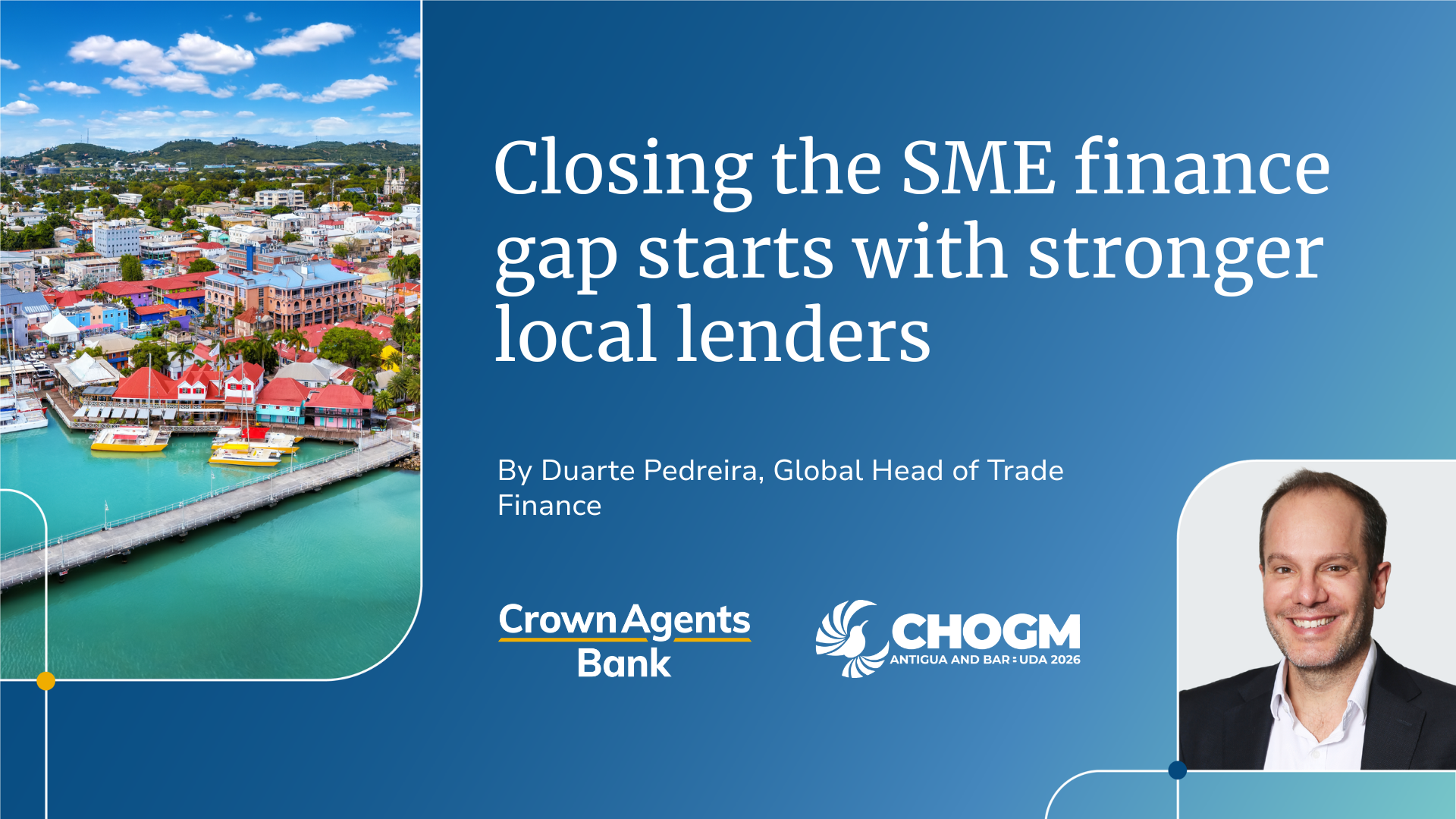
By Neeraj Kapur, Group Chief Executive, Crown Agents Bank
The Commonwealth Secretary-General, Shirley Ayorkor Botchwey, set the Business Forum a clear goal last week at the Commonwealth Heads of Government Meeting (CHOGM): $2 trillion in trade between Commonwealth members by 2030. The Secretary-General told the opening plenary in Antigua that intra-Commonwealth trade reached $874 billion in 2024, up 6.5% in a year1. The direction is right. The question unanswered is how the next trillion gets moved, and by whom.
She was equally clear about where the growth must come from. Ten members, she said, account for almost 90% of intra-Commonwealth trade.2 Three handle 62% of the Commonwealth’s services trade. The developing small states received just 1.5% of intra-Commonwealth investment between 2022 and 2024. Her ask was that members be assessed on objective criteria rather than old notions of risk rooted in historic fears. The $2 trillion will not come from the ten doing more of the same. It will come from the 46 doing what they cannot yet do easily: trade with each other.
Timothy Antoine, Governor of the Eastern Caribbean Central Bank, put a number on the opportunity. Only one dollar in five of Commonwealth members’ trade, he told the Forum, is with each other; in the European Union it is three in five. For 56 nations sharing a language, similar legal traditions and 2.7 billion people, that is a lot of room to grow.
Gaston Browne, Prime Minister of Antigua and Barbuda and host of this year’s Heads of Government Meeting, was specific about what stands in the way: inefficient cross-border payments, inadequate trade finance, and limited access to working capital. A project listed, he said, is not yet a project financed.
The part a bank can answer
Much of the Forum focused on how capital is raised, priced and pledged. The Prime Minister’s list is about how money arrives. A manufacturer in Ghana and a buyer in Saint Lucia can only trade if their banks can settle the payment in days rather than weeks, convert the currency at a fair rate, and finance the shipment in between. Over the past decade, as many global banks withdrew correspondent lines from smaller and frontier markets, that capacity became scarcer, and scarcest for the members with the most to gain.
That is the part of the Commonwealth’s ambition a specialist wholesale bank can help deliver, so let me be specific about ours.
Where Crown Agents Bank stands
Crown Agents Bank has been moving money for Commonwealth governments and institutions for decades. Today we bank clients in 44 of the 56 member states, including every Commonwealth member in Africa and every member in the Caribbean. Around 200 institutions across the Commonwealth use us for payments and foreign exchange, and well over a hundred for trade finance.
We stayed when others left. Where a global bank saw a small market and a compliance cost, we saw a central bank, a development agency or a local lender that still needed to pay and be paid. Our representative office in Guyana is due to open in 2027 at the invitation of the central bank. Across our network we settle in local currencies, so a Kenyan importer and an exporter based in Mozambique are not both routed through the dollar to trade with each other.
We are joining the Pan-African Payment and Settlement System. The Caribbean’s own regional settlement system would be the single most valuable piece of trade infrastructure the region could build this decade. We have the corridors, the local-currency settlement and the central bank relationships to help design and build it, and we are ready to.
In trade finance, we work alongside development finance institutions (DFIs). The deposits that Commonwealth central banks and financial institutions place with us are what fund those corridors. It is a business, and it works because the Commonwealth is a real market, not a sentimental one.
Three ways to get there faster
Governor Antoine set out three imperatives: connect, innovate, deliver. In that spirit, here are three practical suggestions:
First, treat payment connectivity as trade infrastructure. A corridor with a reliable correspondent is as much a trade asset as a port or a road, and it is one the smaller members can secure quickly.
Second, price risk on data. We hold a decade of settlement data across 44 Commonwealth markets and it tells a more encouraging story than the risk premium those markets are often charged. We would gladly put it alongside the Secretariat’s own analysis.
Third, pair commercial banks with the DFIs. Prime Minister Browne asked for exactly this. The DFIs can take the first loss; specialist banks can make the trade happen every day afterwards.
Dr Ngozi Okonjo-Iweala, Director-General of the World Trade Organization, reminded the forum that the Commonwealth is not a region but a family. Families look after each other. Making it easy for members to pay one another is how a family becomes a market, and we intend to keep doing our part.
*Figures as stated by the Secretary-General in her opening plenary address, CHOGM Business Forum, Antigua, 2nd November 2026. The latest published figure is $854 billion in 2022 (Commonwealth Trade Review 2024), which projected intra-Commonwealth trade to exceed $1 trillion by 2026.