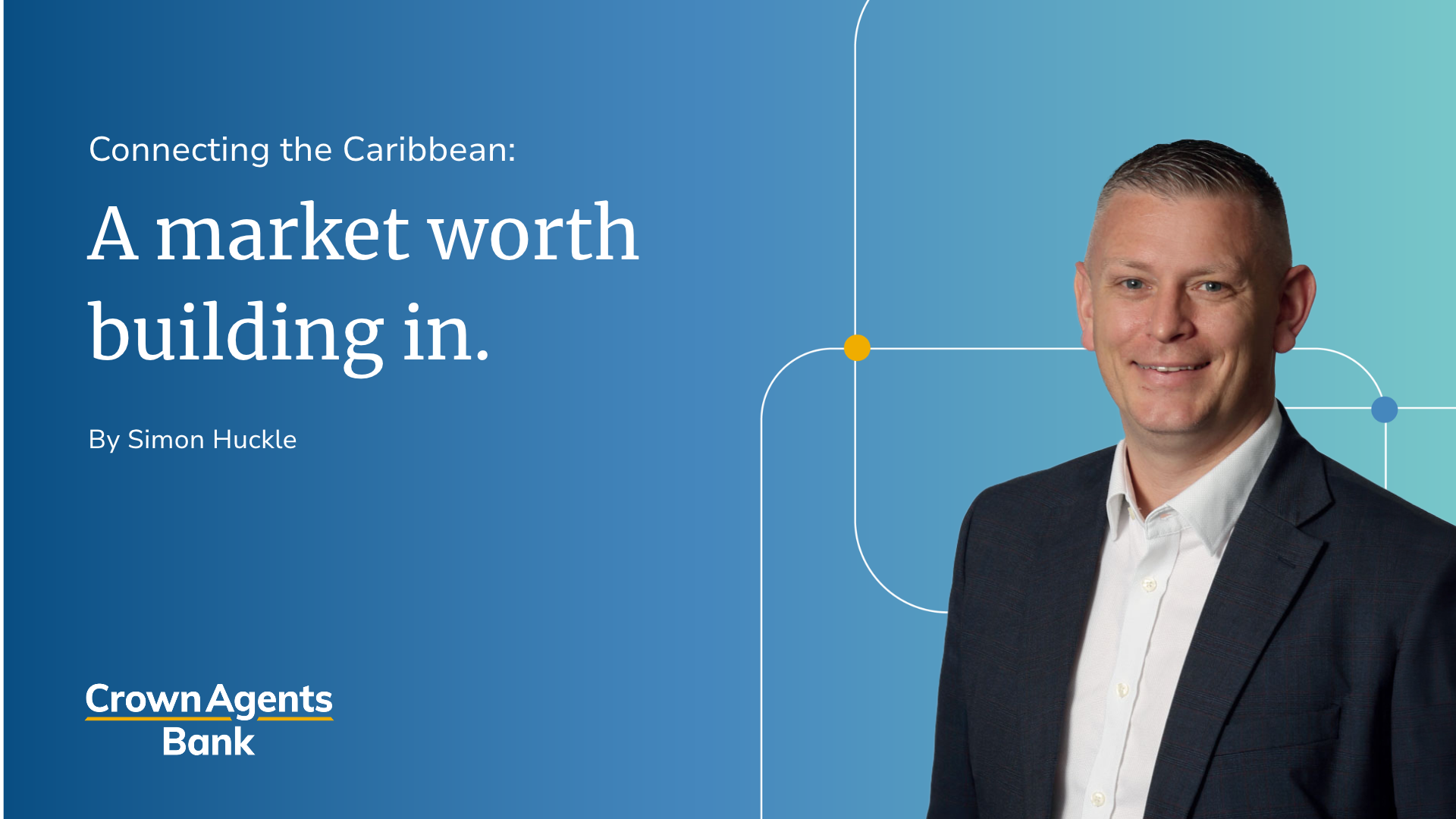
By Jeff Angard, CEO Americas, Crown Agents Bank
Latin America has become one of the most exciting places in the world to build payments. Instant payment schemes, open banking platforms, AI-driven fraud detection and digital onboarding are all moving fast here. Ten years ago, much of it would have sounded like science fiction.
As the region’s banks gather at FELEBAN, much of the conversation will rightly focus on that innovation. I want to focus on something less glamorous: the plumbing underneath it.
Every one of those innovations depends on money actually moving, reliably, from one place to another. Picture a customer in Guatemala paying a supplier in Rotterdam. Or a remittance leaving Madrid for a family’s account in Lima. When that works, nobody notices but when it doesn’t, everybody does.
According to the IDB, families across Latin America and the Caribbean received almost $174 billion from relatives abroad last year, a record. In several of the region’s economies, remittances are a significant share of national income. Every one of those dollars depends on a corridor that stays open.
Six steps, one outcome
Our industry tends to treat an international payment as a technology problem. Build a better API, and the money moves.
But a payment into a complex market isn’t one thing; it is six things happening in sequence, and any one of them can stop it:
Banking infrastructure: an account at each end and a chain of institutions in between.
Currency conversion, at a price someone is willing to quote.
Liquidity: someone actually holding the currency you need, when you need it.
Compliance, done properly, or the payment stops.
Local market access, which usually means someone who knows how that market really works.
Execution: the money arriving on time, for the amount quoted.
Split those steps across six providers and you have six places to fail, with nobody who owns the outcome.
The next decade should not be about faster front ends bolted onto fragmented back ends; it should be about FX, liquidity and payments designed together. That brings the transparency that only comes when one party is accountable for the whole journey.
This matters more because the world has become harder to predict. Trade policy is shifting, not least in the United States – the region’s most important partner. Supply chains built over decades are being redrawn in months. Geopolitical tension is rising, and capital flows into emerging markets are changing direction and speed.
None of this is cause for gloom. Latin America has lived through volatility before and has a remarkable talent for adapting. But it changes the question every bank should ask. It is no longer only “how fast can we move money?” It is also “how sure are we that it will arrive?”
Resilience is the new innovation
For a long time, many banks in the region reached international markets through a few relationships: one or two correspondent banks and a handful of currency routes. It worked well enough until a correspondent cut its exposure to the region, a route became too expensive, or a currency became hard to access.
That has happened repeatedly, often without much warning. From 2015, global banks began ending correspondent relationships in the Caribbean in large numbers, and nearly a third disappeared in seven years. Between 2011 and 2019, Latin America lost around a third of its active correspondent banks, more than any other region.
The reason was simple commercial arithmetic. A global bank providing dollar clearing to a small bank earns modest fees but carries responsibility for everything that flows through. One bad transaction can mean a nine-figure penalty. Weigh small revenue against unlimited risk, and the rational answer is to exit. In some countries, almost every institution lost its correspondent relationships.
When that happens, even the most sophisticated front end can’t help the customer. An app is a nice-to-have when the money is stuck.
Financial infrastructure has often been built the other way round: one correspondent, one route, one currency. Resilience means more than one way to reach the world, partners who understand your market, and access to the currencies your customers actually need.
Stablecoins: Another route, not a new destination
That is the test I would apply to any new technology here. Not “is it faster?” but “does it give me another way through when the first route closes?”
Stablecoins such as USDT and USDC deserve to be judged on exactly those terms. In some cases, they improve speed and access, especially where the alternative is a long chain of intermediaries or no route at all. Anyone in payments who dismisses them isn’t paying attention.
But they are not a challenge to the dollar. They are a dollar in a different wrapper, and their growth is more likely to reinforce the dollar’s primacy than erode it. A region with fully dollarised economies, from Ecuador to Panama to El Salvador, understands this better than most.
A stablecoin moves value between two wallets very efficiently. It does not open an account or convert into a local currency nobody is quoting. On its own, it does not meet regulatory requirements or get funds into a domestic payment system so a supplier can be paid. Those problems are as hard as ever, and they are where cross-border payments mostly fail.
Crown Agents Bank plans to bring a stablecoin proposition to market itself. But stablecoins change one link in the chain and leave the others untouched. They need regulated institutions, FX liquidity, compliance and trusted banking infrastructure around them, arguably more than before.
That is why the region’s forward-looking regulators deserve credit. It is tempting to see regulation as a brake on innovation, but good regulation turns a clever idea into something people can trust with their savings, wages and businesses. Stablecoins and digital assets are already part of cross-border payments. What matters is whether they arrive inside a framework that protects customers, keeps illicit money out and gives banks the confidence to connect. Clear rules don’t hold innovation back – they let it scale.
Being there is the product
Our team has spent recent months across the region, in Guatemala, Honduras and Ecuador. What strikes us every time is how fast the region moves once the constraints lift. Appetite for mobile adoption, digital payments and instant settlement has never been the issue. Infrastructure has.
That is where Crown Agents Bank comes in. In 2015, as global banks pulled out of the Caribbean, we became one of the routes that stayed open. Regional banks that had lost their US correspondents kept access to dollar clearing, and their customers kept access to trade.
We have provided clearing, wholesale FX and cross-border payments in Guyana for thirty years. This year, the Central Bank of Guyana and the Ministry of Finance invited us to establish a permanent presence there. We were one of only three international financial institutions invited.
Thirty years is modest by our standards. Our roots go back to 1833, when “cross-border” meant sailing ships and handwritten ledgers. Today we help banks, central banks, development organisations and businesses move money into and out of complex markets, across 124 currencies and more than 800 currency pairs.
That specialism has taught us two things. First, enduring relationships matter: technology makes payments faster, but trust makes them possible. We invest in knowing the regulators, local banks and realities of every market we serve. Guyana is not an exception; it’s the method.
Second, we see ourselves as partners, not competitors. We want to be the dependable infrastructure behind the region’s banks and fintechs, so they can focus on the innovation their customers love. In an uncertain world, the right partners are the ones still there when conditions are difficult.
Corridors are built together
No single institution can fix cross-border payments alone. That includes the banks, however large, and the fintechs, however fast. It also includes central banks, regulators, payment networks and technology providers.
A corridor has an institution at each end and a regulator overseeing each one. It needs a currency someone is willing to price and a clearing system someone is willing to open. Every link is somebody else’s decision. So a corridor is not something any one of us builds. We agree to build it together, or it doesn’t exist.
FELEBAN understands this better than most. A regional federation exists because no single bank, and no single national association, can solve a region’s challenges alone. A payment corridor is the same kind of agreement.
Crown Agents Bank has worked this way for generations, especially when it matters most. After an earthquake, during a famine, or when conflict cuts a region off, getting money to hard-to-reach places quickly and reliably can be a matter of life and death. It only works when every link in the chain holds.
So speed, on its own, isn’t the goal. Faster is easy to measure and easy to put on a slide. The harder and more valuable goal is resilient corridors. These are routes that hold when trade policy shifts, when a correspondent rethinks its risk appetite, or when a currency becomes hard to access. They let a business in Quito, a bank in Guatemala City and a family in Lima take part in the global economy on equal terms.
When conditions get difficult, customers don’t ask who is fastest. They ask who is still there. That is what participation really requires: not an app, but a route that is still open next year.